It has been hypothesized that radical pairs are formed either after the homolysis of organic molecules or prior to the bond formation between two radical species. However, due to their exceptionally short lifetimes, their structures have been notoriously difficult to probe experimentally. The question then arises: can persistent nitroxyl radicals, such as TEMPO (2,2,6,6-tetramethylpiperidin-1-oxyl), form stable pairs detectable in the gas phase? What is the distance between the two radicals? And are the two unpaired electrons in a triplet or singlet state?
The team of Professor Haoran Li and Associate Professor Yongtao Wang from the Center for Chemistry of High-Performance & Novel Materials at Zhejiang University, in collaboration with the group of Professor Alberto Lesarri at the University of Valladolid, Spain, have successfully achieved the direct detection and structural characterization of radical pairs in the gas phase for the first time. This was accomplished using high-resolution microwave spectroscopy combined with supersonic molecular jet cooling techniques. Through rotational spectroscopy, this study identified two distinct, stable conformations of TEMPO radical pairs in the gas phase, with N···O distances of 3.38 Å and 4.93 Å, respectively (Figures 1-2).
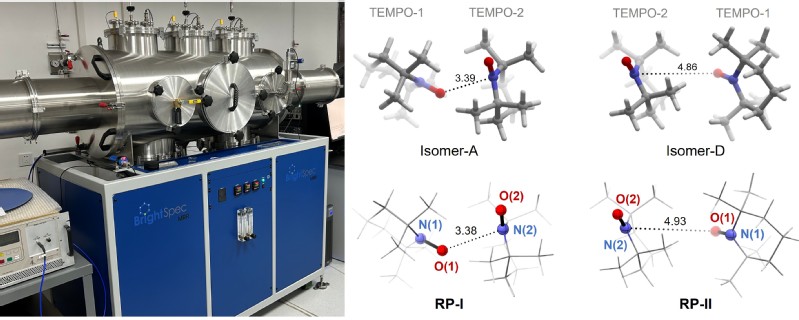
Figure 1: The molecular rotational microwave spectrometer (left) and the theoretically calculated and experimentally determined structures of the two radical pairs (right).
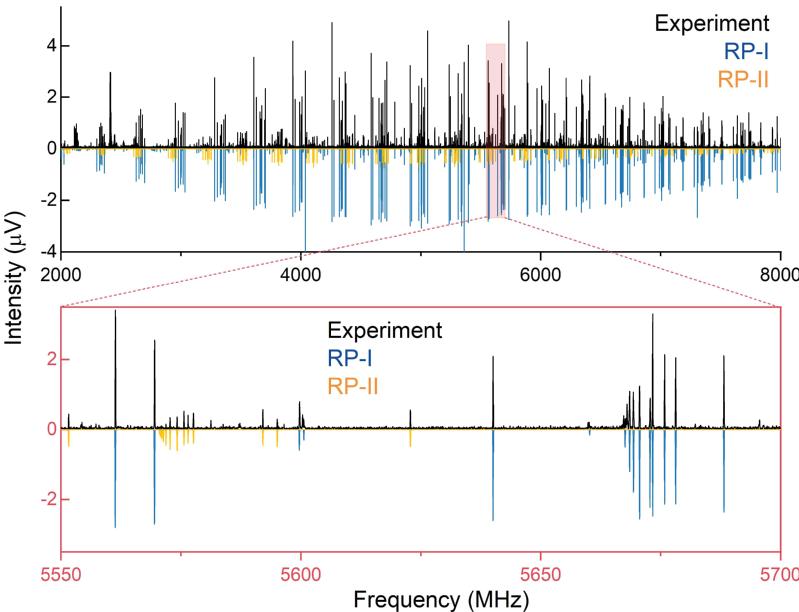
Figure 2: Rotational spectrum of the TEMPO radical (2-8 GHz) and the assignment of spectral lines for the two radical pairs, RP-I and RP-II.
Interestingly, no electron spin hyperfine interactions were observed in the experiment, indicating that the detected radical pairs are not in a triplet state, but rather in a singlet state (Figure 3). Further theoretical calculations and control experiments confirmed that the stability of the TEMPO radical pairs arises from kinetic hindrance.
This study provides, for the first time, experimental data on the geometric and, importantly, electronic structures of radical pairs. Radical-involved reactions constitute a fundamental class of organic transformations; for example, the TEMPO/iron nitrate system developed by the Ma Shengming group has been applied in industrial aerobic oxidation reactions. The structural insights gained from this work are expected to provide crucial clues for the mechanistic study of such reactions.
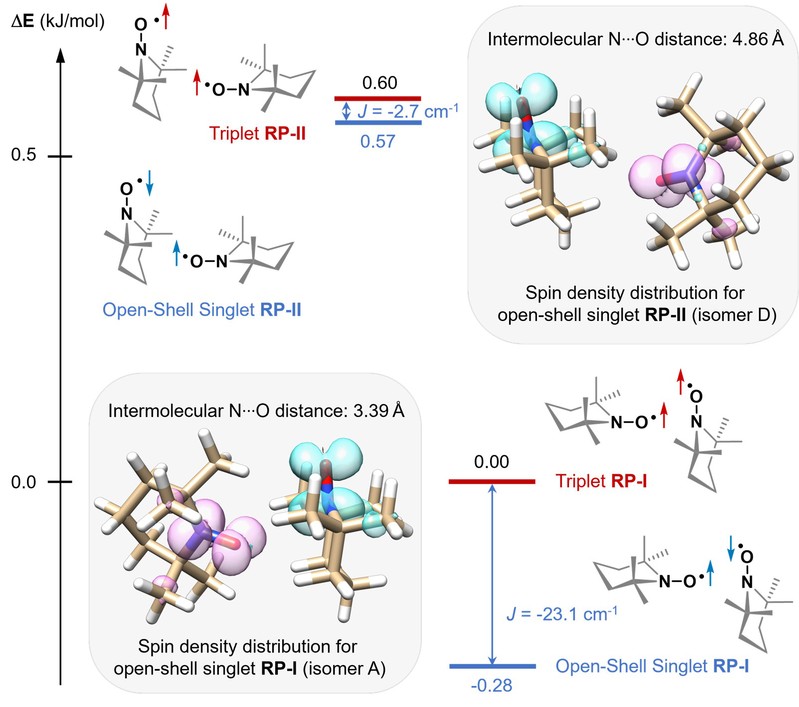
Figure 3: Theoretical computational analysis of the different spin states of the two radical pairs, RP-I and RP-II.
The research findings have been published in Nature Communications. The first author is Associate Professor Yongtao Wang, and the corresponding authors are Professor Haoran Li, Professor Alberto Lesarri, and Associate Professor Yongtao Wang. This research was supported by the National Key Research and Development Program of China (2022YFA1503200), the National Natural Science Foundation of China (22303079), and the Chemistry Instrumentation Center of Zhejiang University.
Original article: https://www.nature.com/articles/s41467-026-74967-0
Title: Rotational observation of kinetically hindered neutral radical pairs
Authors: Yongtao Wang, Wenqin Li, Xiaolong Yi, Xinyu Wang, Meng Li, Jens-Uwe Grabow, Carlos Cabezas, Ibon Alkorta, Cristóbal Pérez, Alberto Lesarri & Haoran Li*