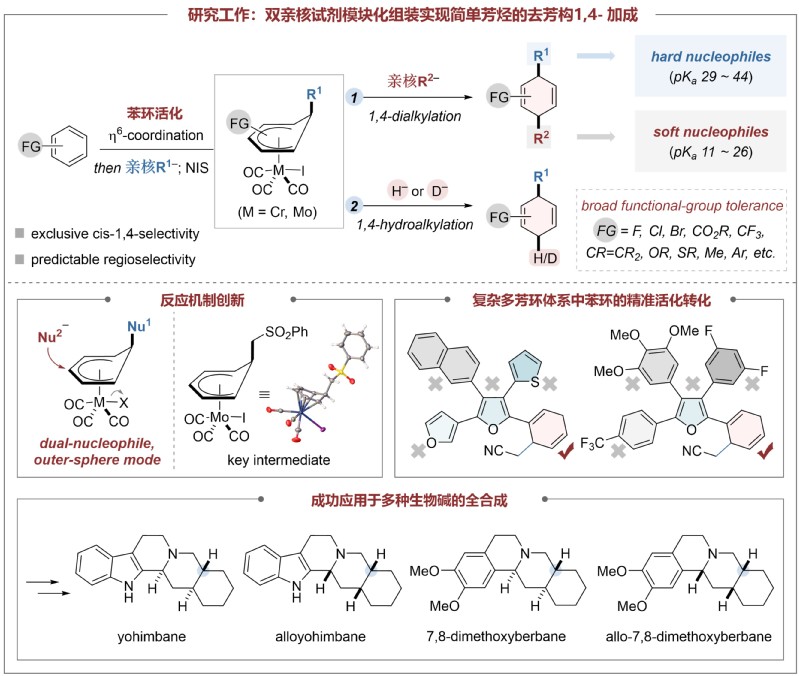
Research Background: Functionalized 1,4-cyclohexadienes are versatile and valuable intermediates in chemical synthesis. The direct construction of these compounds from readily available, inexpensive arene feedstocks via dearomative 1,4-addition represents an ideal synthetic approach. However, achieving intermolecular dearomative 1,4-functionalization of simple arenes has long been a formidable challenge, primarily due to the high stability of the aromatic system and the absence of activating functional groups or directing groups to facilitate activation and control reaction selectivity.
Research Work: Recently, the research group led by Professor Wei Li at Zhejiang University reported a novel regioselectivity control strategy based on η⁶-coordination activation of the benzene ring. This approach enables the dearomative 1,4-dialkylation and 1,4-hydroalkylation of simple arenes, providing an efficient and modular synthetic route to a diverse array of functionalized 1,4-cyclohexadienes.
Key Highlights:
Mechanistic Innovation Overcomes Traditional Selectivity: For a long time, dearomatization reactions of η⁶-coordinated (Cr/Mo) activated arenes have been constrained by an inherent inner-sphere reaction pathway, consistently yielding only 1,2-addition products. By introducing a labile iodine occupying group, the team designed a strategy that reverses the traditional inner-sphere mechanism to an outer-sphere pathway, thereby redirecting the inherent 1,2-selectivity of η⁶-coordination chemistry towards 1,4-addition.
Modular Assembly of Dual Nucleophiles: This method employs two nucleophiles sequentially for addition to the arene. The two nucleophiles can be flexibly and freely combined, demonstrating excellent modular assembly advantages. The two-step nucleophilic attack follows a clear pattern of complementary hardness and softness, which can serve as a practical guide for reaction design: the first nucleophile (initial attack) prefers harder nucleophiles, with pKa values in the range of 29–44; the second nucleophile (attack at the distal carbon) prefers softer nucleophiles, exhibiting good reactivity within a pKa range of 11–26.
Broad Substrate Scope and Precise Benzene Ring Activation: The reaction encompasses a wide range of arenes, from fundamental ones like benzene and toluene to electron-rich, electron-deficient, and poly-substituted arenes. Importantly, it is compatible with sensitive functional groups such as halogens, alkenes, and carbonyls, which are typically intolerant to Birch reduction conditions. Benefiting from the selective recognition of the benzene ring structure through η⁶-coordination, this method enables the precise activation and dearomatization of a specific single benzene ring within complex polyaromatic systems, and has been successfully applied to the late-stage modification of complex drug molecules.
Applications in Total Synthesis: This dearomative 1,4-addition methodology has been successfully applied to the total synthesis of several alkaloids, including Yohimbane, Alloyohimbane, 7,8-Dimethoxyberbane, and Allo-7,8-Dimethoxyberbane.
Dr. Mingyang Wang from the Department of Chemistry, Zhejiang University, is the first author of the paper, and Tenure-Track Professor Wei Li is the corresponding author. This research was supported by the National Natural Science Foundation of China, the National High-Level Young Talents Program, and Zhejiang University.
Paper Information:
Modular Dearomative 1,4-Addition to Simple Arenes with Dual Nucleophiles: Overriding the Inherent 1,2-Selectivity via η⁶-Coordination
J. Am. Chem. Soc.2026, ASAP, doi.org/10.1021/jacs.6c07500
Original article: https://pubs.acs.org/doi/10.1021/jacs.6c07500
Group/PI homepage: https://person.zju.edu.cn/LiLab