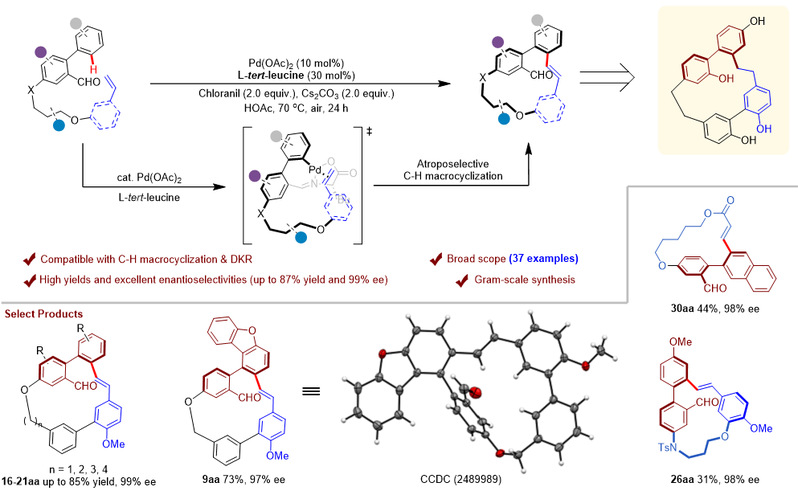
Chiral cyclophanes, a unique class of macrocyclic frameworks combining the rigidity of aromatic rings with the flexibility of aliphatic linkers, are widely found in natural products and pharmaceutically active molecules (e.g., Cylindrocyclophane A, vancomycin). However, the efficient and highly enantioselective construction of such frameworks remains a formidable challenge in synthetic chemistry, primarily due to the inherent entropic penalty and the difficulty in controlling stereoselectivity during asymmetric macrocyclization reactions. Natural products of this class, represented by Isoplagiochin D, exhibit multiple biological activities, including anti-methicillin-resistant Staphylococcus aureus (MRSA), antibacterial, and antifungal properties. Although several asymmetric synthetic routes have been reported, they generally suffer from lengthy procedures, low overall yields, and suboptimal enantioselectivity control. Therefore, the development of a general, concise, and highly enantioselective synthetic strategy is of significant scientific importance and practical value for the efficient preparation of chiral cyclophanes and Isoplagiochin D.
To address these challenges, the research group led by Professor Bingfeng Shi at the Department of Chemistry, Zhejiang University, building on their extensive experience in transient chiral directing group strategies and asymmetric synthesis of cyclophanes, recently reported a novel palladium-catalyzed enantioselective C–H alkenylation/macrocyclization strategy. This method utilizes L-tert-leucine as a chiral transient directing group, successfully enabling the efficient construction of a variety of chiral cyclophanes with different ring systems, affording isolated yields of up to 88% and enantioselectivities of up to 99%. The method was further extended to intermolecular C–H alkenylation reactions, enabling the dynamic kinetic resolution of prochiral macrocyclic substrates. Leveraging this reaction as the key macrocyclization and stereochemistry-determining step, the team accomplished the asymmetric total synthesis of Isoplagiochin D in 10 linear steps, with an overall yield of 16.8% and 97% ee. Furthermore, in conjunction with DFT calculations, they elucidated that the olefin migratory insertion step is both the rate-determining and the enantioselectivity-determining step, rather than the traditionally assumed C–H bond activation step.
This strategy is characterized by its operational simplicity and broad substrate scope, providing a novel and practical synthetic tool for the asymmetric synthesis of chiral macrocyclic natural products and drug molecules, and significantly advancing the development of synthetic methodologies for chiral cyclophane compounds.
The related research findings have been published recently in the Journal of the American Chemical Society under the title Synthesis of Chiral Cyclophanes via Pd(II)-Catalyzed Atroposelective C–H Macrocyclization: Total Synthesis of Isoplagiochin D. The first author of the paper is Dr. Lei Wang from Zhejiang University, and Professor Bingfeng Shi is the corresponding author, with Zhejiang University as the primary affiliation. This research was supported by the National Natural Science Foundation of China, the National Key Research and Development Program of China, and the Ministry of Education's Interdisciplinary Breakthrough Project, among other funding sources.
Original article: https://doi.org/10.1021/jacs.6c10123