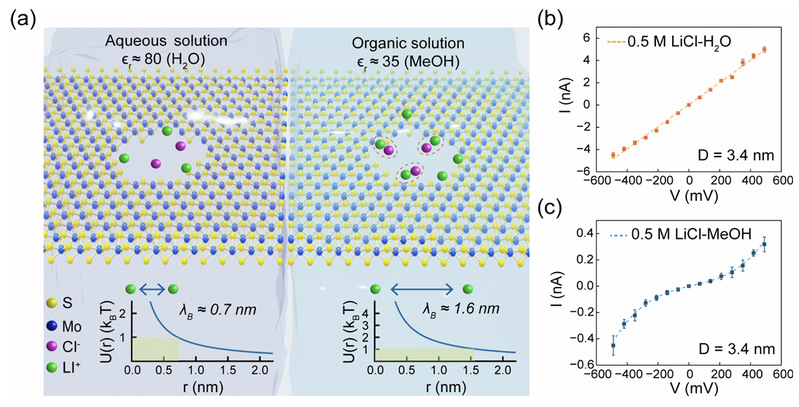
Nanoconfined ion transport is a fundamental process governing energy and matter transfer in nature. Its physical mechanism is regulated by a complex interplay of interface–scale–structure effects, which deviate from classical continuum assumptions and give rise to a variety of unique transport phenomena. Exploring these confinement-mediated fluidic behaviors, developing non-continuum descriptive models, and achieving precise prediction and dynamic control of fluidic transport have been longstanding research hotspots in nanofluidics. These efforts also provide forward-looking insights for applications such as separation, energy conversion, and iontronic circuit design. For an extended period, research on nanoconfined ion transport has primarily focused on aqueous systems, elucidating the modulation of ion energy barriers and interfacial transport by steric effects, dielectric effects, and electrostatic interactions within nanopores (or sub-nanopores). However, in nonaqueous systems, key influencing factors—such as ion–ion and ion–interface electrostatic interactions—can change significantly with the dielectric constant of the solution, and the resulting nanoconfined ion transport behaviors remain largely unexplored.
Recently, the research groups of Professor Jiandong Feng and Dr. Hongzhen Bai from the Department of Chemistry at Zhejiang University, in collaboration with the group of Professor Ruhong Zhou from the College of Life Sciences, successfully extended the study of nanoconfined ion transport to nonaqueous systems (methanol, ethanol, etc.). For the first time, they achieved significant and controllable nonlinear ion transport through single-layer molybdenum disulfide (MoS₂) nanopores with diameters ranging from 2.9 to 7.0 nanometers. They systematically elucidated the influence of the dielectric constant on multiscale, multi-object electrostatic interactions and their regulation of interfacial ion transport. This dielectric engineering strategy expands the tunable dimensions of nanoconfined ion transport, extending the length scale of nonlinear effects from the sub-nanometer to the nanometer regime, thereby opening a new horizon for nanofluidics research.
By combining systematic experimental measurements with all-atom molecular dynamics simulations, the research team proposed a plausible molecular mechanism: the low-dielectric environment significantly enhances electrostatic interactions between ions and the charged nanopore wall. As a result, cations experience a marked reduction in migration velocity when passing through the pore edge due to strong electrostatic attraction. Under higher electric field strengths, this deceleration effect leads to an effective accumulation of cations at the interface. When the positive charge carried by the accumulated cations exceeds the native negative charge of the pore edge, a charge reversal phenomenon, or overscreening, occurs. This process attracts anions and accelerates their translocation through the nanopore, manifesting macroscopically as nonlinear ion transport behavior. This study not only establishes a novel regulatory dimension for nanoconfined ion transport—i.e., directly modulating the range of electrostatic interactions and ionic fluidic behavior by altering the dielectric environment of the solvent—but also provides new insights for the design of biomimetic ionic devices. Furthermore, the introduction of nonaqueous systems is expected to advance nanopore sensing technologies, laying both theoretical and experimental foundations for single-molecule sensing and analysis of hydrophobic species.
The related research findings have been published in the Journal of the American Chemical Society under the title Nonaqueous Ion Transport through Nanopores: A Nonlinear Behavior Driven by Enhanced Ion Correlation. Ph.D. candidates Haojing Tan and Tianhui Tan from the Department of Chemistry at Zhejiang University are the co-first authors of this work.
Original article: https://pubs.acs.org/doi/10.1021/jacs.6c04204