Materials combining high stiffness and exceptional bending durability are critically important for applications in flexible electronics, wearable devices, aerospace equipment, soft robotics, and protective systems. However, these two mechanical properties have traditionally been mutually exclusive in conventional material systems. Inorganic materials such as metals and ceramics offer high stiffness but are prone to fatigue fracture under cyclic bending. Polymers and elastomers, while possessing good flexibility, generally suffer from insufficient stiffness. Although traditional particle-reinforced composites can enhance stiffness, the aggregation of inorganic particles and inhomogeneous interfaces often induce stress concentrations, leading to fatigue failure upon repeated flexing. Consequently, achieving a simultaneous enhancement of stiffness and bending durability remains a significant challenge in materials science.
Recently, the research group led by Professor Zhaoming Liu at the Department of Chemistry, Zhejiang University, extended the concept of interpenetrating double networks to organic–inorganic hybrid systems. They proposed a strategy of replacing inorganic nanoparticles with an inorganic network, wherein a rigid inorganic network and a flexible organic network interpenetrate at the nanoscale, while incorporating dynamic, reversible interfacial bonding. This approach successfully achieves a synergistic improvement in both high stiffness and bending durability (Figure 1).
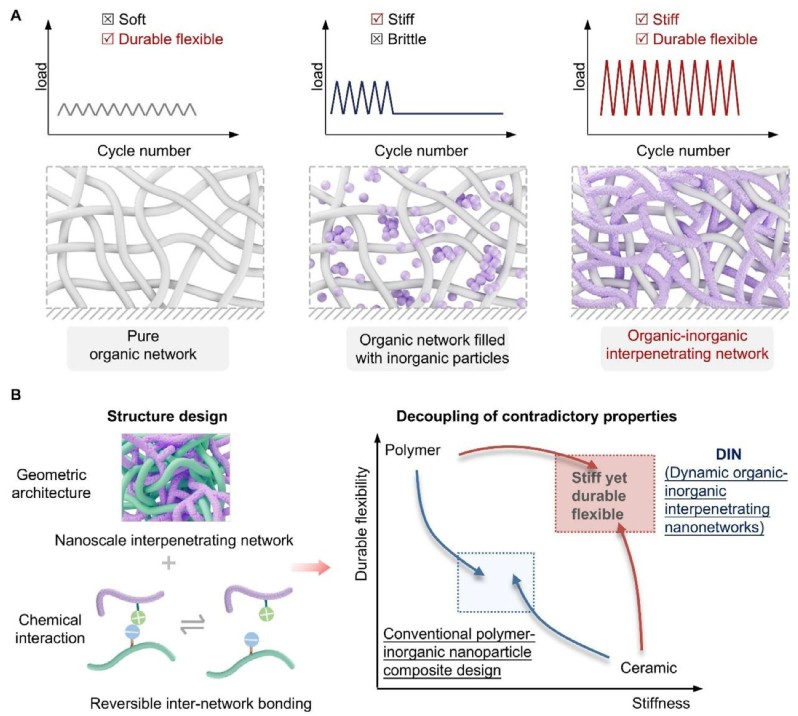
Figure 1: Comparison of mechanical properties of different structural materials and the design principle of the dynamic organic–inorganic interpenetrating nano-network.
The researchers employed molecular-scale calcium phosphate ionic oligomers as the inorganic precursor and bacterial cellulose, which possesses a three-dimensional nanofibrous network structure, as the organic scaffold. Through in situ ionic polymerization, they constructed a bacterial cellulose–calcium phosphate dynamic organic–inorganic interpenetrating nano-network composite. In this composite, the organic cellulose network and the inorganic calcium phosphate network interpenetrate at the nanoscale, forming a homogeneous interpenetrating dual-network structure. Compared with traditional particle-filled composites, this structure significantly increases the interfacial contact area between the organic and inorganic phases, providing a structural basis for stress transfer and energy dissipation. More importantly, dynamic, reversible interactions exist at the interfaces between the two phases. Under external force, these dynamic bonds can act as sacrificial bonds, reversibly dissociating to dissipate deformation energy; upon removal of the force, the interfacial interactions can re-form. This enables a synergistic mechanism wherein the rigid inorganic network bears the load, while the dynamic organic–inorganic interfaces dissipate energy.
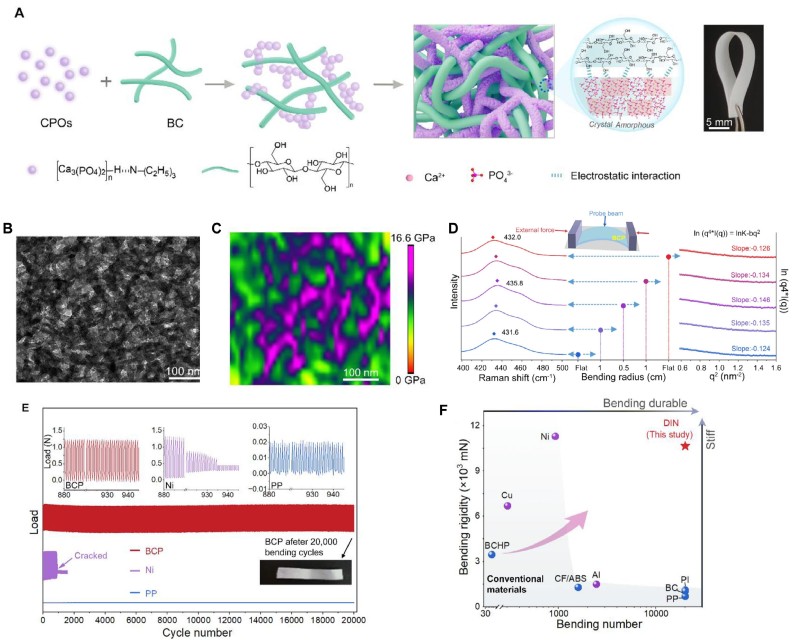
Figure 2: Microstructure and mechanical properties of the organic–inorganic interpenetrating nano-network.
Benefiting from this unique structure, the composite exhibits excellent comprehensive mechanical properties. Its flexural stiffness is comparable to that of metallic nickel, significantly surpassing that of commercial polypropylene, traditional particle-hybridized materials, and previously reported inorganic-fiber-based flexible films. Concurrently, the material did not undergo fatigue fracture even after 20,000 cyclic bending tests, with no significant attenuation in tensile strength, demonstrating exceptional bending fatigue durability and mechanical stability. Furthermore, the material maintains stability across a wide temperature range from –196 °C to 200 °C, does not undergo brittle fracture upon 90° bending even in liquid nitrogen, and retains good mechanical performance under high-humidity conditions (Figure 2).
This study extends the interpenetrating network concept from purely organic systems to organic–inorganic hybrid systems, offering a new design paradigm for overcoming the bending durability challenge in high-stiffness materials. It also provides an important reference for the development of high-performance composite materials intended for protective systems and service in extreme environments. This work was supported by the National Natural Science Foundation of China and Zhejiang University.
Original article: https://advanced.onlinelibrary.wiley.com/doi/10.1002/adma.73753