Natural products and drugs containing long alkyl chains are notoriously difficult to crystallize, rendering the determination of their molecular structures via conventional single-crystal X-ray diffraction (SCXRD) highly challenging, and often impossible. To address this issue, the research group led by Professor Feihe Huang recently reported a molecular catcher technique based on a pillar[5]arene-containing metal-organic framework (MOF). This method enables rapid and accurate structure determination of long-alkyl-chain compounds without the need for growing single crystals of the target analyte. In this approach, pre-synthesized MOF crystals incorporating the pillar[5]arene are soaked in a solution of the target compound. After the target is captured within the MOF crystals, its structure is determined via X-ray diffraction analysis of the loaded crystals.
Specifically, the MOF crystals required for the protocol described in this paper are prepared from a laboratory-synthesized pillar[5]arene derivative, a commercially available tetraphenylethylene derivative, and zinc nitrate hexahydrate in N,N-dimethylformamide (DMF). The resulting crystals are washed with fresh DMF to remove unreacted starting materials and can be used directly for target compound capture without the need for additional solvent exchange. The most critical step is the selection of MOF crystals of suitable size and quality. After soaking the selected MOF crystals in a solution of the target compound, crystals suitable for X-ray diffraction analysis are obtained. The entire process—from starting materials to final crystal structure determination—can be completed within 10 days. This paper provides a detailed protocol for the synthesis and guest-capture operations of this molecular catcher technique for structural identification, along with comprehensive experimental details, including representative examples and a troubleshooting guide, to facilitate the broader adoption of this technology.
The molecular catcher technique proposed by Professor Feihe Huang's team is characterized by its experimental simplicity, short measurement time, and broad substrate scope, holding substantial promise for the structural determination of pharmaceuticals, natural products, and synthetic organic compounds. This technology offers a novel conceptual strategy for framework-based structural analysis, significantly advancing the field of structure elucidation. The related work, titled Synthesis and guest inclusion for molecular catcher-based structure determination, was published in Nature Protocols on May 27, 2026. The co-first authors are Dr. Yitao Wu from Zhejiang University and Dr. Lei Xu from Nanjing University. The corresponding authors are Professor Feihe Huang from Zhejiang University and Professor Jonathan L. Sessler from the University of Texas at Austin. Zhejiang University is the primary affiliation. This research was supported by the Zhejiang Provincial Natural Science Foundation Major Project (LD26B020001), the Zhejiang Province 'Pioneer' and 'Leading Goose' R&D Program (2025C04010), the National Natural Science Foundation of China (22320102001, 22350007), and the Ministry of Education's Interdisciplinary Breakthrough Project for Special Polymers (JYB2025XDXM407). The work also received technical support from the Chemistry Instrumentation Center of Zhejiang University.
Original article: https://doi.org/10.1038/s41596-026-01370-w
Title: Synthesis and guest inclusion for molecular catcher-based structure determination
Authors: Yitao Wu,# Lei Xu,# Shang Li, Hongyan Zhang, Shiyuan Wang, Jiahao Yu, Jiyong Liu, Jonathan L. Sessler* & Feihe Huang* Nature Protocols (2026).
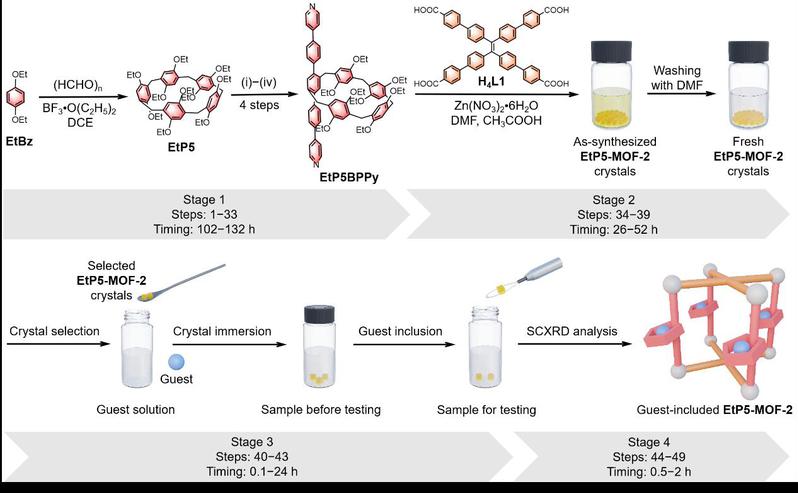
Schematic representation of the synthetic route and standard guest-capture procedure for the molecular catcher-based structure determination technique.
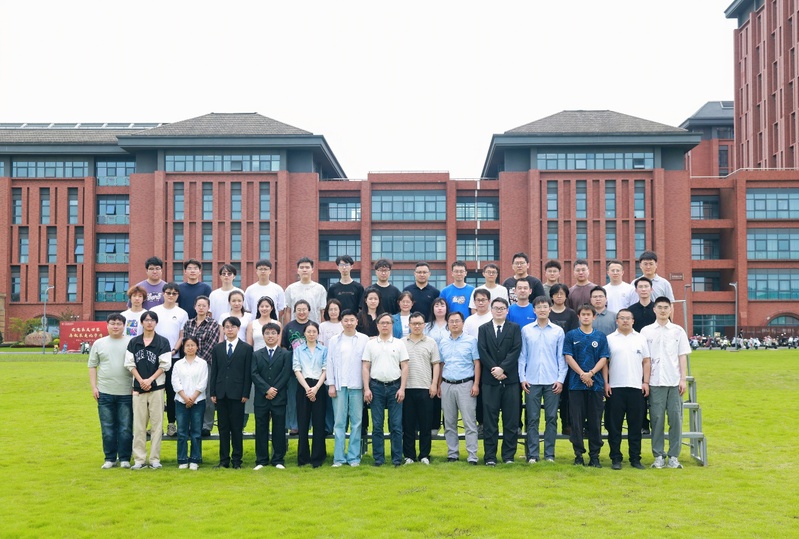
Group photo of Professor Feihe Huang's team.