Xenon (Xe) is a chemically inert noble gas with exceptionally high chemical stability; however, its nuclear magnetic resonance (NMR) signal is exquisitely sensitive to its local environment. Leveraging hyperpolarization techniques, which can enhance signal intensity by tens of thousands of times, xenon has emerged as a highly promising probe for biosensing and magnetic resonance imaging (MRI) applications. Nevertheless, the efficient capture of xenon in solution using synthetic molecular cages has posed a significant challenge, primarily because xenon is a nonpolar, highly symmetric atom that lacks polar recognition sites.
To address this challenge, supramolecular chemists have designed and synthesized a series of macrocycles or cage molecules that exploit size complementarity between their cavities and the xenon atom, achieving xenon recognition and storage in the solid state or in solution. Given the nonpolar nature of xenon, it has been generally presumed that recognition is predominantly governed by London dispersion forces between the host and the xenon atom. Although this hypothesis is plausible, it has long lacked direct experimental validation—chemists have faced difficulty in definitively proving or disproving the relative importance of dispersion forces in xenon recognition, or in distinguishing these forces from mere solvophobic effects.
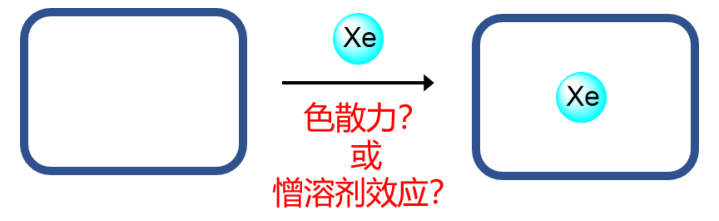
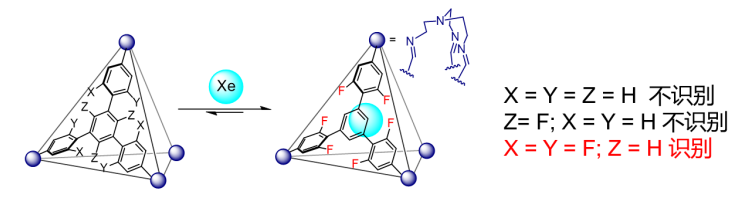
To tackle this fundamental question, the research team at Zhejiang University introduced fluorine atoms onto the host framework to achieve xenon recognition. While isolated fluorine atoms are considered difficult to polarize, within a molecular context, fluorine atoms withdraw electron density from other atoms in the molecule via inductive effects. The resulting increase in charge density renders the molecule more polarizable, thereby enabling F···Xe interactions to drive the recognition of xenon within the cage cavity. Through modular self-assembly, the team efficiently synthesized a series of tetrahedral cage molecules with similar structures and sizes, differing only in the number and positioning of fluorine atoms. A systematic comparative study revealed clear structure–activity relationships: cages lacking fluorine atoms capable of providing dispersion forces, those with insufficient fluorine atoms, or those where fluorine atoms were positioned on the exterior of the cavity, all failed to recognize xenon. This provides the first experimental evidence that xenon recognition is predominantly driven by dispersion forces. These findings establish a definitive design principle for the future development of hyperpolarized ¹²⁹Xe-based biosensing and imaging platforms.
This work has been published in the Journal of the American Chemical Society (DOI: 10.1021/jacs.6c04503). The first author is Yuyang Lu, a 2026 Master's graduate from Zhejiang University. The corresponding authors are Professor Hao Li and Professor Hongliang Chen from the Department of Chemistry, Zhejiang University.