In fields spanning chemistry, physics, life sciences, and deep-space exploration, the visualization of localized multi-physical fields remains a core bottleneck constraining major scientific discoveries. Traditional functional imaging is heavily dependent on fluorescence, yet the vast majority of key physicochemical processes do not inherently produce luminescent signals. Conversely, conventional techniques such as electrochemistry and electron spin resonance either suffer from insufficient spatial resolution or limited informational dimensions, or are incapable of achieving spatiotemporally parallel in situ measurements.
To address these challenges, the team led by Professor Jiandong Feng has proposed the concept of quantum chemical imaging. This approach employs quantum sensing to detect changes in physical quantities generated locally during chemical reactions, enabling spatiotemporally resolved measurements with parallel readout for chemical system imaging. Building on this concept, they have developed a proprietary quantum chemical microscope (QCOM), achieving innovations from fundamental principles and key technological breakthroughs to system integration and multi-scenario applications.
During a chemical reaction, unpaired electrons from free radicals interact with nitrogen-vacancy (NV) centers; this interaction can be converted into imaging contrast via relaxation measurements, enabling in situ imaging with a spatial resolution of approximately 312 nm and a sensitivity down to 4 radical species. In photocatalytic water-splitting reactions, the team directly captured the spatiotemporal dynamics of radical generation, observing a previously unreported sequential activation phenomenon. This work achieved the direct visualization of the spatiotemporal kinetics of radical formation during photocatalytic reactions. The findings have been published in Nature Catalysis. Article link: https://www.nature.com/articles/s41929-026-01499-7. The first authors are Yibo Yang (Ph.D. student, Department of Chemistry, Zhejiang University) and Zengrong Zhou (research assistant, Zhejiang University).
The quantum chemical microscope also offers a novel technological pathway for the analysis of deep-space exploration samples. The origin of localized magnetic anomalies on the Moon has been a long-standing challenge in planetary science. Magnetic surveys from orbital lunar probes at kilometer-scale resolution, or bulk magnetic analyses of returned lunar rock samples, have failed to elucidate the microscopic carrier mechanisms. In collaboration with the team of Professor Jinhua Li at the Institute of Geology and Geophysics, Chinese Academy of Sciences, the Feng Jiandong group utilized the quantum chemical microscope to conduct single-particle magnetic imaging of lunar soil from China's Chang'E-5 mission—the first such report internationally. This work provides direct microscopic evidence for lunar magnetic anomalies. The related research has been published in the Chinese journal Fundamental Research. Article link: https://doi.org/10.1016/j.fmre.2025.12.007. The first authors are Yibo Yang (Ph.D. student, Zhejiang University) and Lin Xing (Ph.D. student, Institute of Geology and Geophysics).
Based on their pioneering work at the interface of quantum sensing and chemical measurement, Jiandong Feng and colleagues published a review article titled Quantum Sensing-Driven Chemical and Biological Measurements in Science Foundation in China. In this paper, they formally introduce the concept of quantum chemical measurement, systematically outline the core challenges in this emerging area of chemistry, and discuss future directions for the field.
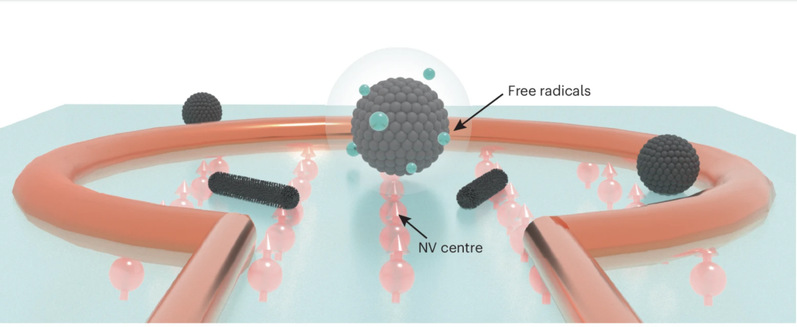
Figure: Schematic diagram of the NV quantum sensing–photocatalytic reaction interface.
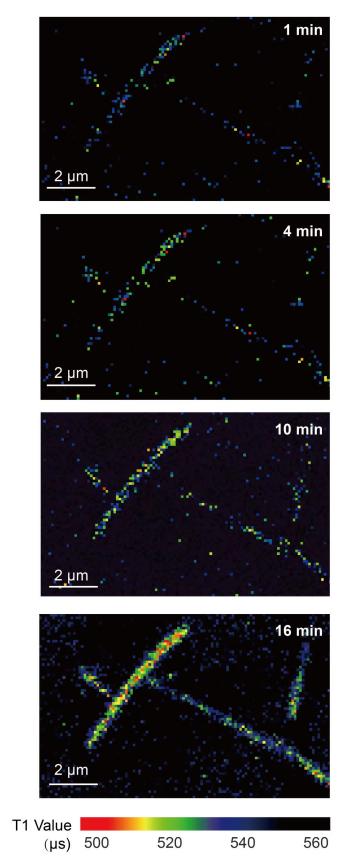
Figure:In situ spatiotemporally resolved imaging of radical generation on a TiO₂ catalyst.