Interfacial charge transfer (CT) in low-dimensional semiconductor organic–inorganic heterostructures is a central process governing the efficiency of optoelectronic devices. However, whether and how the anharmonic dynamic lattice characteristics inherent to low-dimensional semiconductor materials influence CT kinetics has long lacked definitive experimental evidence and a clear physical picture.
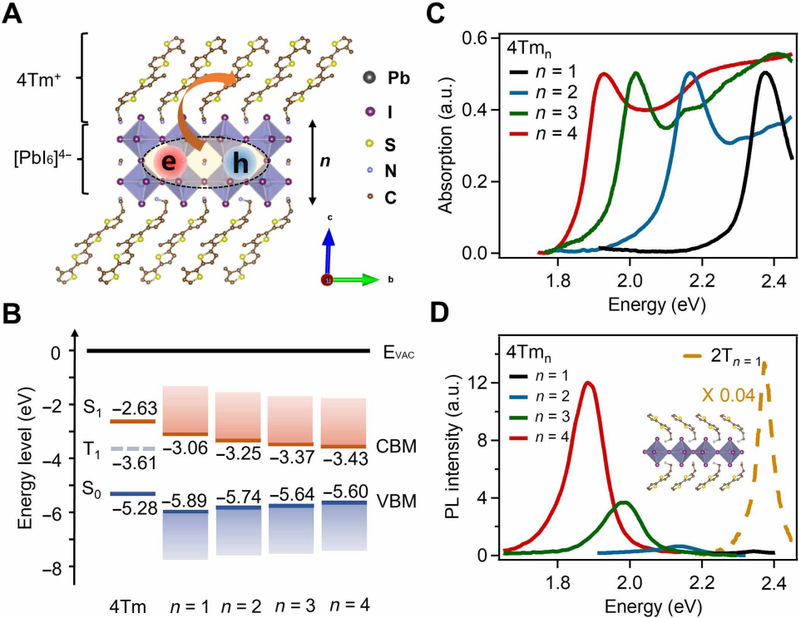
Recently, the research group led by Professor Haiming Zhu at Zhejiang University, in collaboration with the team of Professor Run Long at Beijing Normal University, has for the first time systematically elucidated the dynamic lattice charge transfer mechanism at two-dimensional (2D) organic–inorganic interfaces. Using a model system of quaterthiophene-based active ligand/2D lead–iodide perovskite semiconductors, and combining femtosecond transient absorption spectroscopy with first-principles calculations, the study revealed a universal two-step CT process from the inorganic layer to the organic layer following photoexcitation of the inorganic framework. This process entails an ultrafast (sub-picosecond to picosecond) hole transfer, followed by a slower (tens to hundreds of picoseconds) electron transfer, ultimately populating the triplet state of the organic ligand.
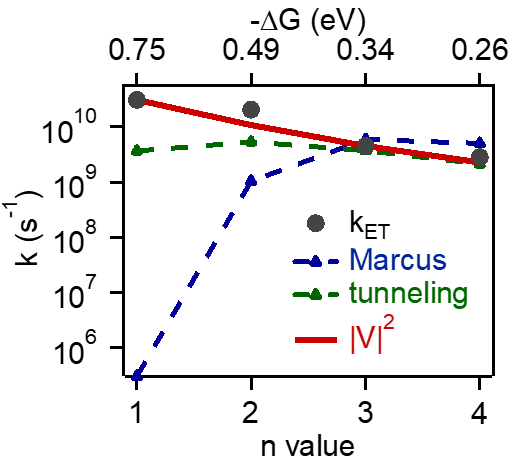
Surprisingly, although the CT driving force could be continuously tuned from 0.16 eV to 0.75 eV by varying the inorganic layer thickness *n*—spanning both the normal and inverted regions of the Marcus CT model—the experimentally observed rates for both hole and electron transfer monotonically increased with decreasing *n*, without any signature of inverted-region behavior. Furthermore, these rates exhibited a remarkable temperature independence across the range of 80 K to 295 K. This anomalous behavior cannot be rationalized by the classical Marcus model or by quantum tunneling models.
In response to this phenomenon, the research team proposed, for the first time, a dynamic lattice CT model: the strong anharmonic lattice of the 2D lead–iodide perovskite undergoes persistent structural fluctuations under thermal perturbation, enabling the system to sample a vast ensemble of transient lattice configurations. Consequently, CT can always proceed via pathways with near-zero energy barriers. First-principles molecular dynamics calculations corroborated this model, demonstrating that even at a cryogenic temperature of 80 K, substantial lattice disorder persists. The transient driving forces, reorganization energies, and activation energies exhibit broad distributions, with a significant population of CT channels possessing near-zero barriers. This model successfully accounts for the observed thickness-dependent trend in CT rates, which are primarily determined by the electronic coupling term, yielding results in near-quantitative agreement with experimental observations.
This discovery transcends the limitations of static energetic considerations in traditional CT models, establishing dynamic lattice disorder as a core design principle for achieving highly efficient CT. It opens new avenues for developing next-generation optoelectronic materials that operate beyond the constraints of static energy alignment. The findings have been recently published online in Science Advances.
The corresponding authors of this work are Professor Haiming Zhu from Zhejiang University and Professor Run Long from Beijing Normal University. The first authors are Tianjing Li, a Ph.D. student in the Department of Chemistry at Zhejiang University, and Haoran Lu, a Ph.D. student at Beijing Normal University. Zhejiang University is the primary affiliation. This research was supported by the National Natural Science Foundation of China and related platform projects.
Original article: Tianjing Li#, Haoran Lu#, Ming Xia, Weijian Tao, Yao Zhang, Guohua He, Enzheng Shi, Run Long, Haiming Zhu. Dynamic lattice disorder overrides energetics for barrierless interfacial charge transfer in 2D hybrid perovskites. Sci. Adv.12, eaeb8615 (2026).