The development of inorganic-organic hybrid solid-state electrolytes that combine high ionic conductivity with exceptional stability represents a promising pathway toward the practical application of solid-state lithium metal batteries. Metal-organic frameworks (MOFs), constructed from metal nodes and organic linkers via strong coordination bonds, have emerged as a compelling class of solid-state electrolyte materials, effectively bridging the gap between inorganic and polymer-based systems. Furthermore, MOF-based solid-state electrolytes offer structural diversity, highly tunable pore environments, and the capability for site-specific functionalization—particularly through the anchoring of anionic groups onto metal clusters, which significantly facilitates lithium-ion conduction.
Recently, the research group led by Professor Zhijie Chen at our department reported the reticular assembly of an anionic zinc–triazolate-based metal-organic framework (Zn-TBTB). This MOF features a cage-within-cage structure and adopts a complex (3,6,6)-connected pco merged network. The structural attributes of this merged network endow Zn-TBTB with high electrochemical stability and a modular, mixed-anion-coordination pore environment, thereby enabling a wide voltage window and low-temperature lithium-ion conduction. The findings have been published in the Journal of the American Chemical Society under the title Reticular Assembly of Complex Cage-within-Cage Merged-Net MOFs for Lithium-Ion Conductivity.
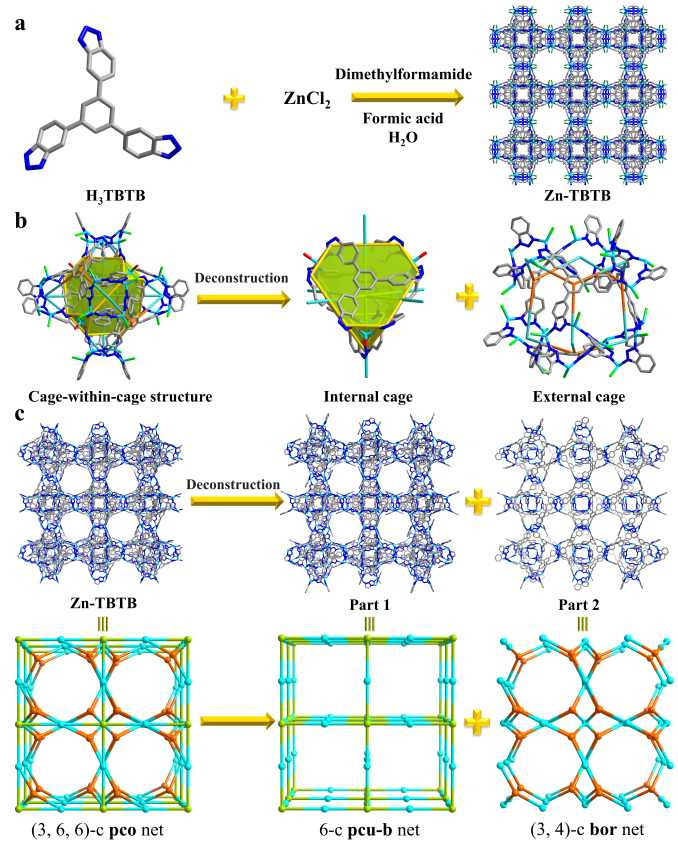
Figure 1. Schematic of the assembly of Zn-TBTB and the generation of the pco topological network.
A three-connected phenyl-tribenzotriazole ligand was designed and synthesized. Single-crystal X-ray diffraction analysis revealed that the material crystallizes in the cubic crystal system (space group F3̄*c*), with a topology based on a (3,6,6)-connected pco merged network—derived from the merging of pcu-b and bor networks. This marks the first experimental realization of this topological network in a MOF.
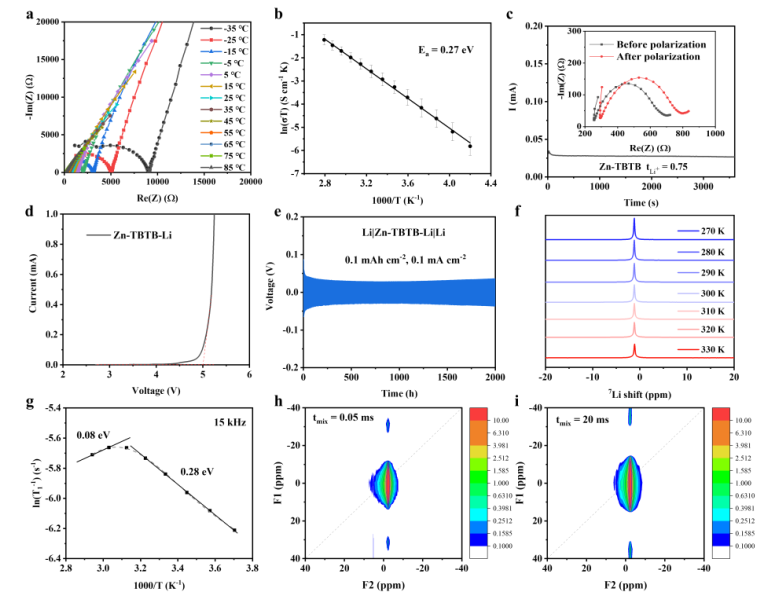
Figure 2. Ionic conductivity performance of Zn-TBTB-Li.
The unique cage-within-cage structure and the complex pco merged network of Zn-TBTB confer excellent thermal, chemical, and hydrolytic stability, as corroborated by PXRD and N₂ sorption measurements. This multi-component merged network not only provides a robust framework but also offers a modular pore environment with mixed-anion coordination sites for lithium-ion conduction. Li⁺-exchanged Zn-TBTB-Li was subsequently obtained. A combination of characterization techniques (PXRD, XPS, ICP, NMR, and N₂ sorption) collectively confirmed the successful exchange of lithium ions into the channels of the anionic framework while maintaining the framework integrity. Zn-TBTB-Li exhibited average ionic conductivities of 1.84 × 10⁻⁴ S cm⁻¹ at 25 °C and 6.13 × 10⁻⁵ S cm⁻¹ at –5 °C, with an activation energy of 0.27 eV.
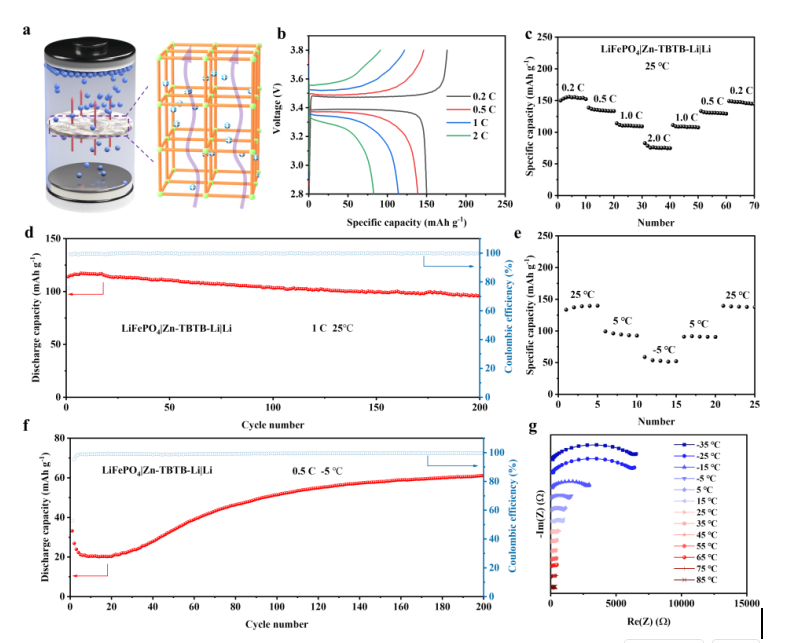
Figure 3. Performance testing of lithium metal batteries based on a Zn-TBTB quasi-solid-state electrolyte.
The assembled quasi-solid-state lithium metal batteries demonstrated excellent rate capability. At 25 °C, the battery delivered a high capacity retention of 85% and a high Coulombic efficiency of 99.7% after 200 charge–discharge cycles. At 0.5 C, the discharge capacity remained at 62 mAh g⁻¹ after 200 cycles. These results underscore the favorable temperature tolerance and stability of Zn-TBTB-Li.
In summary, this work advances the application of MOFs with merged-network structures in solid-state electrolytes. The multi-component merged network provides a stable structural platform and a modular pore environment with mixed-anion coordination, enabling highly efficient lithium-ion conduction.
The first affiliation of this paper is the Department of Chemistry, Zhejiang University. Professor Zhijie Chen is the corresponding author, and Ph.D. candidate Zhangyi Xiong is the first author. Graduate students Liang Gu, Mengyang Zhai, Honghao Cao, and Xiangchuanlan Zhang, as well as undergraduate students Yinan Zhang and Duyi Cao, contributed to this work. The authors also acknowledge testing assistance from Senior Engineers Jiyong Liu, Di'er Shi, and Lina Gao at the Analytical and Testing Platform. This work was financially supported by the National Natural Science Foundation of China, the Natural Science Foundation of Zhejiang Province, and the Fundamental Research Funds for the Central Universities.
Original article: Zhangyi Xiong, Liang Gu, Mengyang Zhai, Honghao Cao, Yinan Zhang, Xiangchuanlan Zhang, Duyi Cao, Zhijie Chen*. Reticular Assembly of Complex Cage-within-Cage Merged-Net MOFs for Lithium-Ion Conductivity. J. Am. Chem. Soc.2026, DOI: 10.1021/jacs.6c02393.
About the First Author:
Zhangyi Xiong is a Ph.D. student (enrolled in 2023) whose research focuses on the design and synthesis of functional crystalline porous materials and their performance in ion batteries. Since joining the program, he has published papers as the (co-)first author in the Journal of the American Chemical Society (2 papers), CCS Chemistry (1 paper), ACS Central Science (1 paper), and Chemical Engineering Journal (1 paper). He has also been awarded the 2026 Zhejiang Provincial Applied Basic Research Program New Seedling Project (Doctoral Student Project).
Group/PI homepage: https://person.zju.edu.cn/zhijiechen