Metal-organic frameworks (MOFs), a class of porous crystalline materials constructed from metal ions/clusters and organic linkers via coordination bonds, have garnered significant interest across diverse fields, including gas storage, separation, catalysis, and atmospheric water harvesting, owing to their structural designability and functional tunability. Nevertheless, a persistent challenge in this domain is achieving precise structural control over frameworks that incorporate supramolecular hosts with intrinsic conformational flexibility—such as organic cages—while concurrently preserving their host–guest recognition functionalities.
Recently, the research group led by Professor Zhijie Chen at our department reported a π-extension reticular chemistry strategy, rooted in the principles of reticular design. This approach enabled the successful construction of a series of zirconium-based MOFs (Zr-PC-MOFs) with highly controllable architectures, which exhibited outstanding performance in iodine adsorption applications. This work offers a fresh perspective for the design of functional porous materials. The findings have been published in CCS Chemistry under the title Reticular Chemistry with π-Extended PrismCage Building Units. This work was financially supported by the National Natural Science Foundation of China (Nos. 22471237 and 22201247), the Natural Science Foundation of Zhejiang Province (No. LR25B010001), and the Fundamental Research Funds for the Central Universities (No. 226-2025-00108).
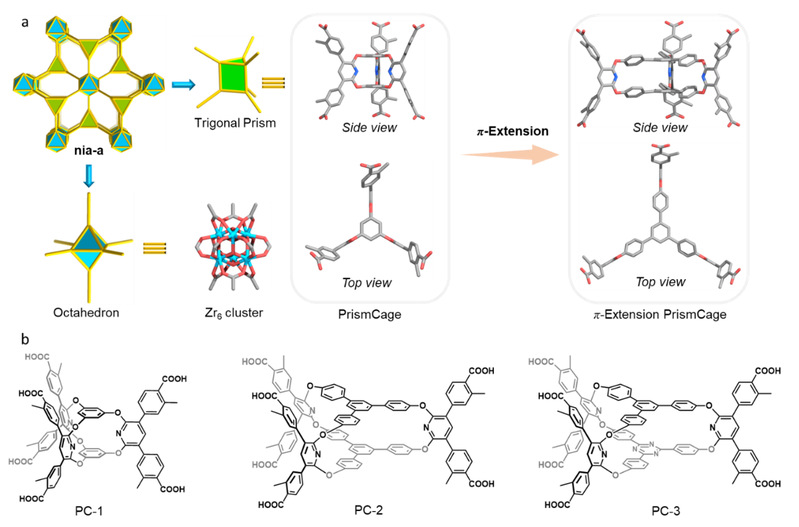
Figure 1: (6,6)-connected nia network constructed from octahedral Zr₆ clusters and π-extended trigonal prismatic cage-type organic linkers.
In this study, the team employed an oxygen-bridged trigonal prismatic PrismCage—an organic cage featuring both well-defined geometry and host–guest chemistry characteristics—as the core building unit. By assembling this unit with octahedral Zr₆ oxo clusters, they synthesized Zr-PC-1-nia, which adopts a (6,6)-connected edge-transitive nia network. Single-crystal X-ray diffraction analysis revealed that the material crystallizes in a hexagonal space group, forming a three-dimensional periodic structure with two distinct types of cavities.
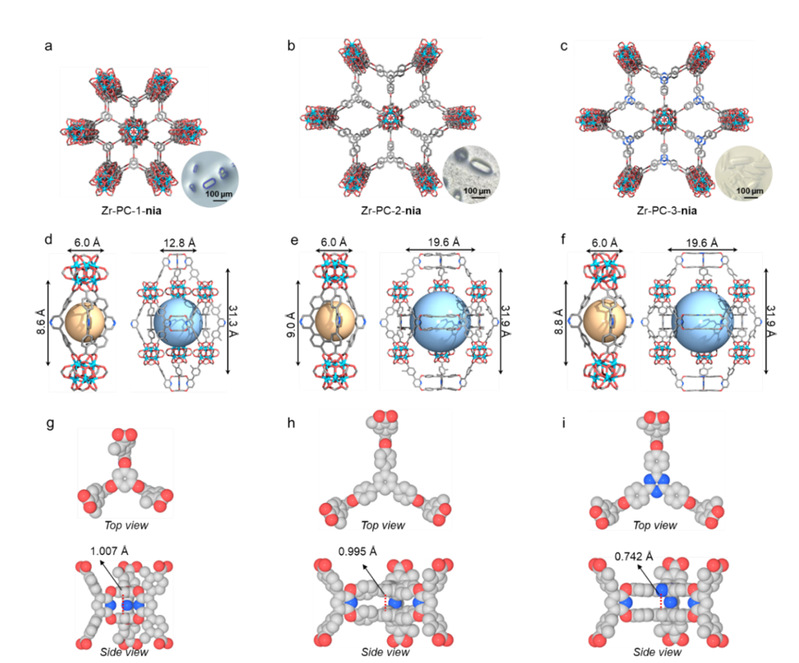
Figure 2: Crystal structures of the Zr-PC-MOFs.
To further modulate the pore architecture and enhance molecular recognition capabilities, the researchers implemented a π-extension strategy, synthesizing two PrismCage ligands with extended conjugated systems: PC-2, bearing an electron-rich benzene core, and PC-3, featuring an electron-deficient triazine core. Under identical synthetic conditions, these ligands successfully yielded Zr-PC-2-nia and Zr-PC-3-nia, which are isoreticular to Zr-PC-1-nia. Crystallographic analysis demonstrated that as the ligand conjugation length increased, the diameter of cavity II within the framework expanded from 12.8 Å (in Zr-PC-1-nia) to 19.6 Å, accompanied by notable changes in the planarity and interlayer spacing of the aromatic rings within the organic cages. N₂ sorption experiments revealed Brunauer–Emmett–Teller (BET) surface areas ranging from 1960 to 2060 m² g⁻¹ for the three materials, with pore size distributions in excellent agreement with the crystallographic data.
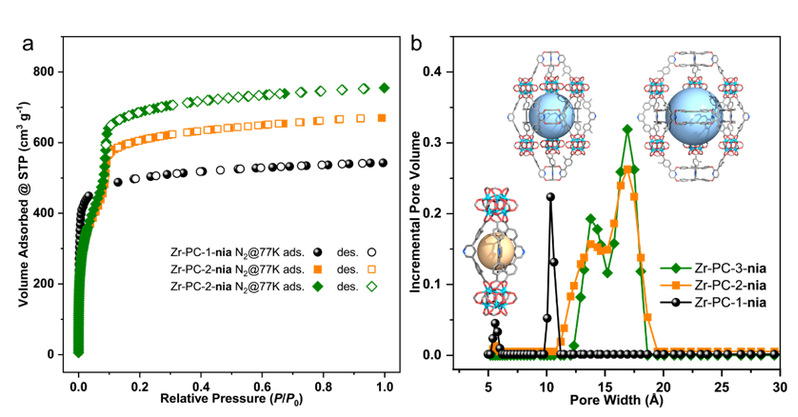
Figure 3: N₂ sorption isotherms and pore size distribution profiles.
In terms of application, the research focused on the safe capture of radioactive iodine from the nuclear industry. Compared to conventional adsorbents such as aerogels and zeolites, MOFs offer distinct advantages for iodine sequestration, attributable to their high specific surface areas, tunable channels, and abundant functional sites. Experimental results indicated that Zr-PC-3-nia achieved an iodine removal efficiency of 85% within 2 hours, markedly surpassing those of Zr-PC-1-nia (29%) and Zr-PC-2-nia (50%).
Through X-ray photoelectron spectroscopy, Raman spectroscopy, and theoretical calculations, the interaction mechanism between iodine species and the framework was elucidated. The results revealed that iodine predominantly exists as I₂ and I₃⁻ species within the pore channels, forming charge-transfer complexes with the electron-rich aromatic rings and nitrogen-containing sites. Cyclic adsorption–desorption experiments further confirmed that all three materials maintained high adsorption efficiencies over four cycles, demonstrating excellent reusability. Density functional theory (DFT) calculations showed that the binding energies between the π-extended PrismCage ligands and iodine molecules were significantly enhanced, increasing from –4.68 to –8.88 kcal mol⁻¹ for PC-1 to –11.40 to –19.38 kcal mol⁻¹ for PC-2 and PC-3, corroborating the critical role of extended conjugation in strengthening host–guest interactions.
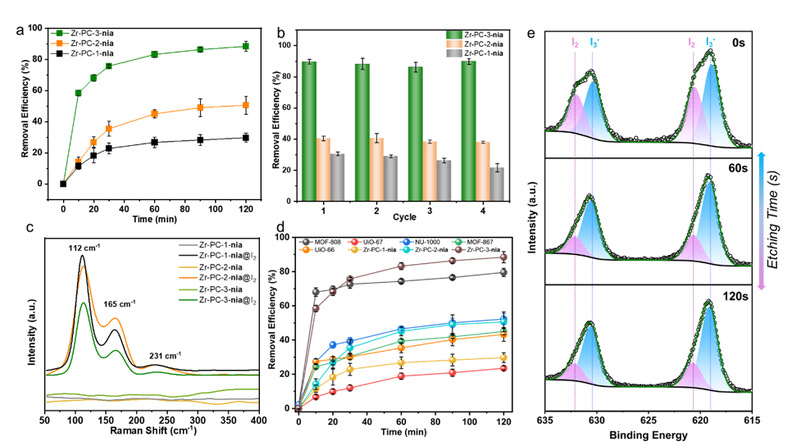
Figure 4: Investigation of iodine adsorption performance.
The novelty of this work lies in the successful demonstration that the π-extension strategy enables not only precise modulation of pore dimensions and surface chemical environments in organic cage-based MOFs but also substantial improvement in their molecular recognition and adsorption functionalities. The research team noted that this strategy provides a viable pathway toward the construction of supramolecular host-based framework materials with both structural predictability and functional designability, thereby holding promise for advancing applications in separation, sensing, and environmental remediation.
For further details, please refer to the original article: https://www.chinesechemsoc.org/doi/10.31635/ccschem.026.202607596
Group/PI homepage: https://person.zju.edu.cn/zhijiechen