Interface charge and spin transfer represent the core and critical steps in energy conversion fields such as photocatalysis and photoelectric conversion. However, at the atomically thin interfaces of two-dimensional semiconductors, the key species and charge transfer channels involved in the interfacial charge transfer process after photoexcitation have long been a research bottleneck due to the great challenges in detection.
Recently, the research group of Haiming Zhu from our department has employed spin-resolved ultrafast spectroscopy technology and leveraged the intrinsic spin degree of freedom to achieve, for the first time, the direct observation of the entire process of hot charge-transfer exciton formation and cooling at low-dimensional interfaces. Taking the WSe₂/MoS₂ heterojunction as the model system, the research team innovatively used circularly polarized light to realize the selective excitation of specific spin excitons in the WSe₂ layer, and accurately captured the dynamic changes in the energy and spin states of electrons after their injection into the MoS₂ layer via real-time tracking technology. In the experiments, a typical two-phase (hot and cold) charge transfer process was discovered for the first time at low-dimensional interfaces: the initial stage involves an ultrafast (≈0.1 picosecond) spin-conserved electron injection, where electrons form weakly bound delocalized hot charge-separated excitons containing hot electrons in the acceptor phase; subsequently, the hot electrons undergo slow cooling within the layer over hundreds of femtoseconds to reach the band edge, ultimately forming stable tightly bound interlayer excitons.
Since the hot electron relaxation process is significantly slower than the charge transfer process, electrons and holes in the hot state can maintain a transient loosely bound and delocalized state. This characteristic lays a crucial foundation for achieving long-range charge separation and high-efficiency photoelectric conversion. To further verify this rule, the research team conducted spin-resolved ultrafast spectroscopy measurements on a three-layer heterojunction. The experimental results directly confirmed that hot electrons can achieve ultrafast long-range charge separation across the intermediate layer through a spin-conserved pathway, providing strong support for the conclusions of this study.
This work establishes a unified physical picture for understanding charge and spin transfer as well as charge separation at low-dimensional interfaces, and offers new insights for the design of high-performance optoelectronic devices and photocatalysts.
The corresponding author of this paper is Researcher Haiming Zhu from Zhejiang University, and the first author is Cheng Sun, a PhD candidate in the Department of Chemistry, Zhejiang University. The research findings were published in Journal of the American Chemical Society (2026, 148, 6, 6511–6519), and were supported by the National Natural Science Foundation of China, the Natural Science Foundation of Zhejiang Province, and other projects.
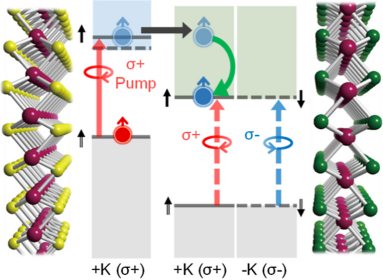
Spin-Conserved Hot Charge Transfer Exciton Formation and Cooling at the Two-Dimensional Semiconductor Interface
Cheng Sun, Yangyi Shi, Hongzhi Zhou, Xiangyu Shen, and Haiming Zhu*
https://pubs.acs.org/doi/10.1021/jacs.5c20527